
Words for your people
Wedding newspaper wording: 18 examples to make your own.
Start with a welcome, finish with a thank-you, and give practical details clear labels in between. These original examples help you find the words without making every section sound like the same letter. Choose the ones you need and replace the details with your own.
What do you write in a wedding newspaper welcome message?
Welcome the people holding the paper, add one true detail about what having them there means to you, and invite them to enjoy the day. Keep your relationship story for the inside pages and practical instructions under clear headings. For example: “Our favourite people, all in one place. Thank you for being here to celebrate with us. Make yourself at home, meet someone new, and save us a dance.”
All examples below are writing prompts, not accounts of real weddings. Times, places, people and arrangements are illustrative. Use only details that are true for your day. Lengths are editorial starting points; your template’s space and preview decide what fits.
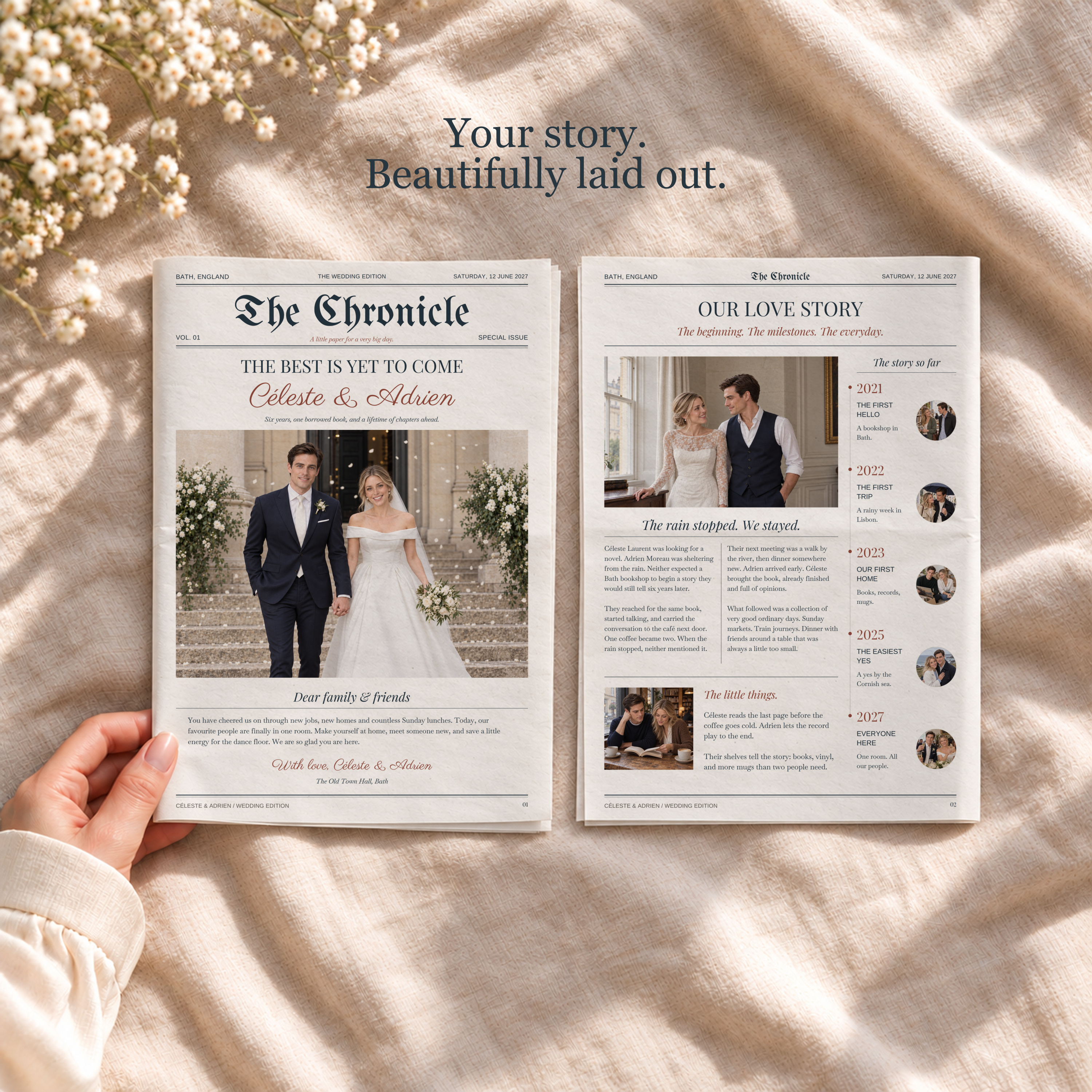
Give each page a different job
A newspaper becomes repetitive when the welcome, story and thank-you all say how happy you are that everyone came. Let the welcome address your guests, the story explain something about you, the schedule help people navigate, and the closing leave them with your thanks.
| Page | What the words do | Starting length |
|---|---|---|
| 1 · Welcome | Acknowledge your guests and invite them into the day. | About 30–60 words for a compact note. |
| 2 · Story | Share how you met and one or two details guests may not know. | About 80–150 words if your template allows. |
| 3 · Practical details | Give clear times, locations, roles and requests. | One short instruction per note; labelled lines for the timetable. |
| 4 · Thanks | Say what your people mean to you and close with your names. | About 25–50 words for a small closing block. |
These are suggested writing budgets, not Vowfold field limits or a requirement to fill every space. A shorter paragraph with one personal detail is more useful than a longer one built from general praise. See the complete four-page plan for photographs, timelines and optional sections.
Five wedding newspaper welcome messages
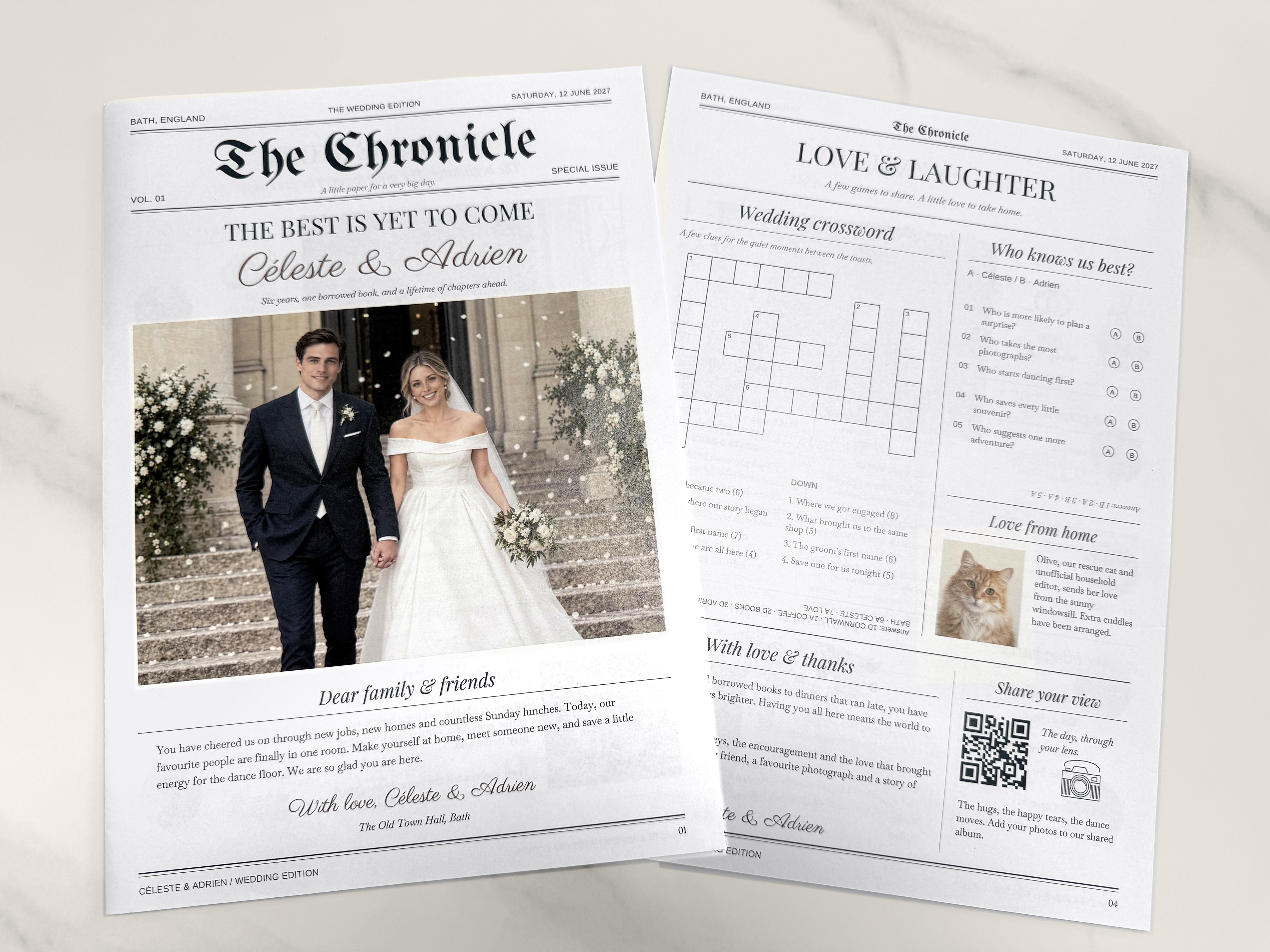
A useful formula is welcome + one true observation + an invitation. Address “you” or “our family and friends”. Write as both partners unless the note is deliberately signed by someone else. You do not need to retell your relationship on the cover.
1. Short and warm
Our favourite people, all in one place. Thank you for being here to celebrate with us. Make yourself at home, meet someone new, and save us a dance.
A compact cover welcome. Replace the final invitation if dancing is not part of your celebration.
2. Relaxed, with a little humour
You have heard about each other for years. Today you finally get to meet. We are so happy to have our families, old friends and new friends around the same tables. Introduce yourself, swap a story about us, and enjoy the day.
The joke welcomes everyone into the room. Avoid references that need a private backstory to make sense.
3. For guests who have travelled
Thank you for making the journey to be with us. We know a weekend away takes planning, and having you here means so much. We hope you find time for a slow breakfast, a little exploring and a long conversation with someone you have just met.
Use this if it reflects your plans. Keep hotel, travel and breakfast arrangements in a practical section, so the welcome does not imply that something is provided.
4. For a small wedding
There are only a few seats around our table, and each one belongs to someone we love. Thank you for sharing this day with us. We hope this little paper gives you a few new stories, even if you have known us for years.
Works for an intimate meal or ceremony. There is no need to explain the guest-list decisions in your newspaper.
5. A more formal welcome
Welcome to our wedding, and thank you for joining us. We are grateful to celebrate with the family and friends who have supported us throughout our lives. Please enjoy this glimpse of our story and the day we are so pleased to share with you.
Keep the names, date and venue in the cover details rather than repeating them inside every paragraph.
If none sounds quite like you, start with “We are so glad you are here” and add something specific: the Sunday lunches you have shared, the friends finally meeting, or the small town everyone has gathered in. One real detail changes the tone more than several decorative adjectives.
Four wedding newspaper thank-you notes
The closing can be more personal than the welcome. Name the care people have shown, then end simply. A newspaper thank-you addresses the group; you can send individual thanks separately for specific gifts or help.
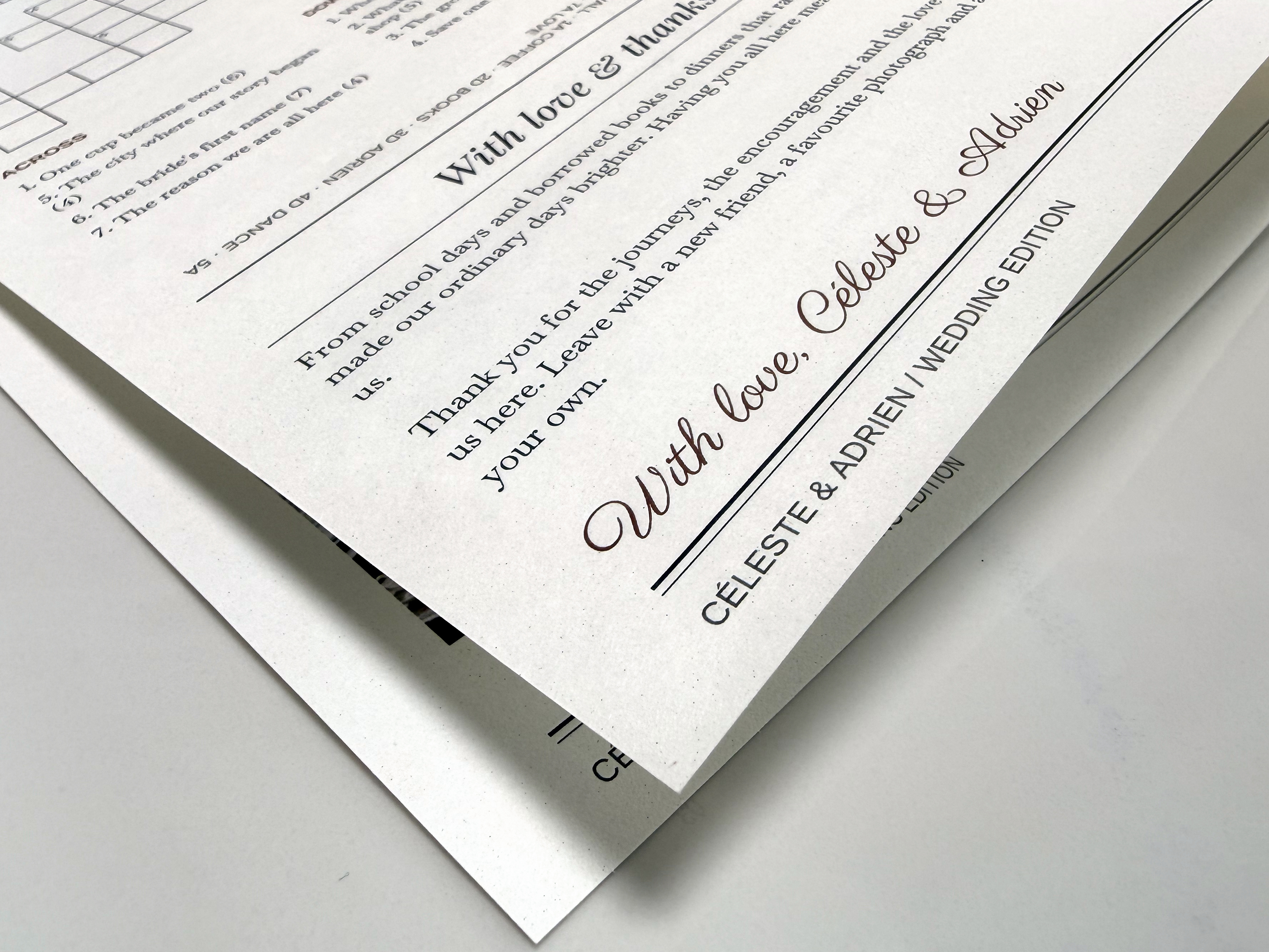
6. A short closing thank-you
Thank you for your kindness, your company and the part you play in our lives. We are so happy to share today with you. Take this paper home with our love.
Useful for a small closing space. Your names can sit beneath it as a signature.
7. Thanking people for their help
To our families and friends: thank you for the lifts, the phone calls, the patient advice and the many small things that brought us here. We have felt your care at every step. Today is happier because you are part of it.
Replace the examples of help with things people actually did. If you name individuals, check names and make sure you both agree on whom to include.
8. For a wedding weekend
Thank you for giving us a whole weekend of your company. We hope you leave with a new friend, a favourite photograph and a story to tell on the way home. Having our people together is the part we will remember most.
Write in the present or future for a newspaper handed out during the celebration. Use past tense only if you are sending it afterwards.
9. For a newspaper sent after the wedding
We are still smiling about the day we shared with you. Thank you for the conversations, the laughter and the care you brought to our wedding. Here are a few moments to keep until we can look through the photographs together.
Use this for a later keepsake edition. Update any “today” references and replace expired practical instructions before sharing it.
If the cover already thanks guests for travelling, use the back page to recognise their friendship or support. Avoid making attendance sound like a debt. A simple “having you with us means so much” says enough.
Nine practical guest notes to adapt
Put the important action first. Then give the place, time or reason needed to carry it out. A warm tone helps, but guests should not have to decode a joke to find their transport.
10. An unplugged ceremony
Please put phones and cameras away during the ceremony so we can enjoy this moment together. There will be time for photographs afterwards. Thank you for being here with us.
Agree the request and the later photo opportunity with your partner and ceremony team. Put it where guests will see it before the ceremony.
11. Sharing guest photographs
We would love to see the day through your eyes. Scan here to add your favourite photographs to our shared album. Thank you for helping us keep the little moments, too.
Use beside a working album QR. Check upload permissions on a guest’s phone, including whether a sign-in is needed. The album service supplies uploads; the wording alone does not create that feature.
12. Keeping photographs off social media
We are keeping wedding photographs within our circle for now. Please enjoy taking pictures after the ceremony, share them with us directly, and wait for us to post before putting them online.
Choose a request you both mean. This asks for delayed public posting, while the previous example invites album uploads; decide whether you need both.
13. Getting home
Coaches leave from the main entrance at 11.30 pm. Please be there ten minutes before departure. Ask our coordinator if you need help finding your coach.
These are fictional arrangements. Replace the time, meeting point and helper with confirmed details. Do not print a private phone number without the person’s agreement.
14. Finding the next part of the day
After the ceremony, please join us for drinks in the courtyard. Our team will show you the way. Dinner is in the Garden Room at 5.00 pm.
Use the actual venue names guests will see on signs. Confirm the route and time, and agree a weather alternative with the venue if needed.
15. A gentle gift-registry invitation
Having you here is what matters most to us. If you would like to give a gift, our registry is linked here. Thank you for thinking of us.
Only use beside the intended registry link or QR. If you prefer no gifts, say so directly and omit the registry invitation.
16. Remembering someone you love
Remembering those we love who cannot be here today. We carry their kindness and their stories with us as we begin this next chapter.
Keep this optional and agree the words with the people closest to the loss. A name, a small memory or no public note at all can each be the right choice.
17. Introducing the wedding party
Alex · Person of honour. Friend since our first flatshare, keeper of the emergency snacks and the person who knows where we left everything.
A fictional introduction. Use the person’s preferred name and role, followed by one detail they are happy to share. Save confidential stories for another setting.
18. Inviting guests into a game
A little challenge while you wait: how well do you know us? Circle your guesses, compare notes with your table, and ask us for the answers later. No prizes, just possible bragging rights.
Match the instruction to the actual activity and have an answer plan. If you promise prizes or an announcement, assign someone to deliver them. Add pens.
Use only the notes your guests need. If your ceremony has a longer running order or readings, follow the newspaper order-of-service guide. For a real activity to accompany example 18, choose from the quiz questions and printable wedding games.
Turn a generic message into your own: a worked edit
Start with facts before polishing sentences. Imagine a couple whose friends know them for Sunday lunches, whose families are meeting for the first time, and who plan to dance after dinner. Those are the only details needed for this fictional edit.
Before: a message that could belong to anyone
We are absolutely delighted and incredibly grateful to welcome each and every one of you to this wonderful celebration of our love. Your presence on this very special occasion means more than words can express, and we hope you have a truly unforgettable day.
After: the same job, with a recognisable detail
You have joined us for years of Sunday lunches. Today, you finally get to meet each other. Thank you for being here. Pull up a chair, swap a story, and save us a dance after dinner.
The edit replaces repeated intensifiers with one shared memory, speaks directly to the guests and gives them an invitation. It does not add a proposal story or a long list of names. If you do not host Sunday lunches, swap that detail for something you really do.
- Write three notes. Who are you welcoming? What have they shared with you? What do you hope they enjoy?
- Choose one detail. Keep the other memories for the story or timeline.
- Read it aloud together. Replace any phrase neither of you would say.
- Cut repeated thanks. Keep one clear thank-you rather than three versions of it.
- Check it in the layout. A sentence can read beautifully in a document and still be too long for a newspaper column.
For the longer relationship section, use the separate love-story examples and prompts. That article develops the narrative; this one supplies the welcome, closing and useful notes around it.
Choose clear headings, then add personality
The masthead is the newspaper’s name. The cover headline celebrates the marriage. A section heading helps guests find something. They do not all need the same joke or the same phrase.
| Purpose | Clear option | More playful option |
|---|---|---|
| Cover headline | Together with Our Favourite People | Good News: We’re Getting Married |
| Welcome | A Note to Our Guests | Our Favourite People, One Room |
| Day’s timetable | Order of the Day | Here’s the Plan |
| Closing thanks | With Our Thanks | For Everyone Who Got Us Here |
Keep transport, ceremony and photo instructions easy to recognise. A heading such as “The Great Escape” may be charming, but “Coaches home” tells a guest exactly where to look. Adjust headline length to your names, font and available space rather than squeezing the type smaller.
Where these words fit in Vowfold
In the four-page Chronicle layout, the welcome belongs on the cover and the closing thanks on page four. The day’s schedule and practical details belong on page three. Your wording and selected optional sections change the content within the designed layout; Vowfold keeps the fonts, colours and page positions set.
Use these examples as source material, not a promise that every paragraph fits every field unchanged. Paste a short version into the relevant section, use the editor’s length guidance, and preview the full page. If a note is too long, remove a repeated thought before shortening names or important instructions.
The optional sharing area can link to your photo album or gift registry; choose the destination you want and test it. Your purchased online-newspaper reading link and its delivered QR image open the newspaper itself. They do not automatically become a guest photo-upload album. See the online sample to understand that reading experience.
Not every guest-note example has a dedicated field. Use the matching available section, shorten it to fit, or put it on a separate sign or wedding website. For more page choices, inspect the four-page template, then try your own words in a free preview. Physical printing is separate from the digital newspaper purchase.
Check the copy before you finalise it
- Facts: confirm names, pronouns, roles, venue labels, times and transport arrangements.
- Voice: make sure both partners are comfortable signing the words.
- Tense: “today” for a paper given out at the wedding; past tense for a keepsake sent afterwards.
- Instructions: every “scan here”, “ask our coordinator” or “meet outside” needs a working destination, a real person or a clear place.
- Privacy: get agreement before publishing a personal story, contact detail or named remembrance.
- Repetition: let each section add something; print the full timetable in one place.
- Fit: check the smallest text in the actual PDF and on a printed proof. Use the size and PDF guide if you are changing print formats.
Wedding newspaper wording questions
How long should a wedding newspaper welcome be?
For a compact cover, start with about 30–60 words: one welcome, one personal detail and one invitation. This is a writing suggestion, not a fixed rule. Your actual layout may allow a different length; preview it with your own photograph and names.
Can we use these examples as they are?
You can borrow the wording for your own wedding newspaper, but replace the illustrative facts and remove anything that does not apply. One true detail will make it feel more personal. Recheck practical arrangements before printing.
Should the welcome include our love story?
A hint is enough. The welcome speaks to your guests; the inside story gives you space to explain how you met. Repeating the same paragraph on both pages uses room without giving the reader anything new.
How do we make it funny without embarrassing anyone?
Use a shared habit, a gentle observation or a joke about yourselves. Leave out ex-partners, private difficulties and stories the subject would not want printed. Ask a friend unfamiliar with the joke to read it; if it needs explaining, simplify it.
Does the back-page thank-you need to name everyone?
No. You can thank the group warmly, then name particular people only where it feels right and there is space. A short note can carry more meaning than a list that leaves someone out.