
Printing · A practical copy count
How many wedding newspapers do you need?
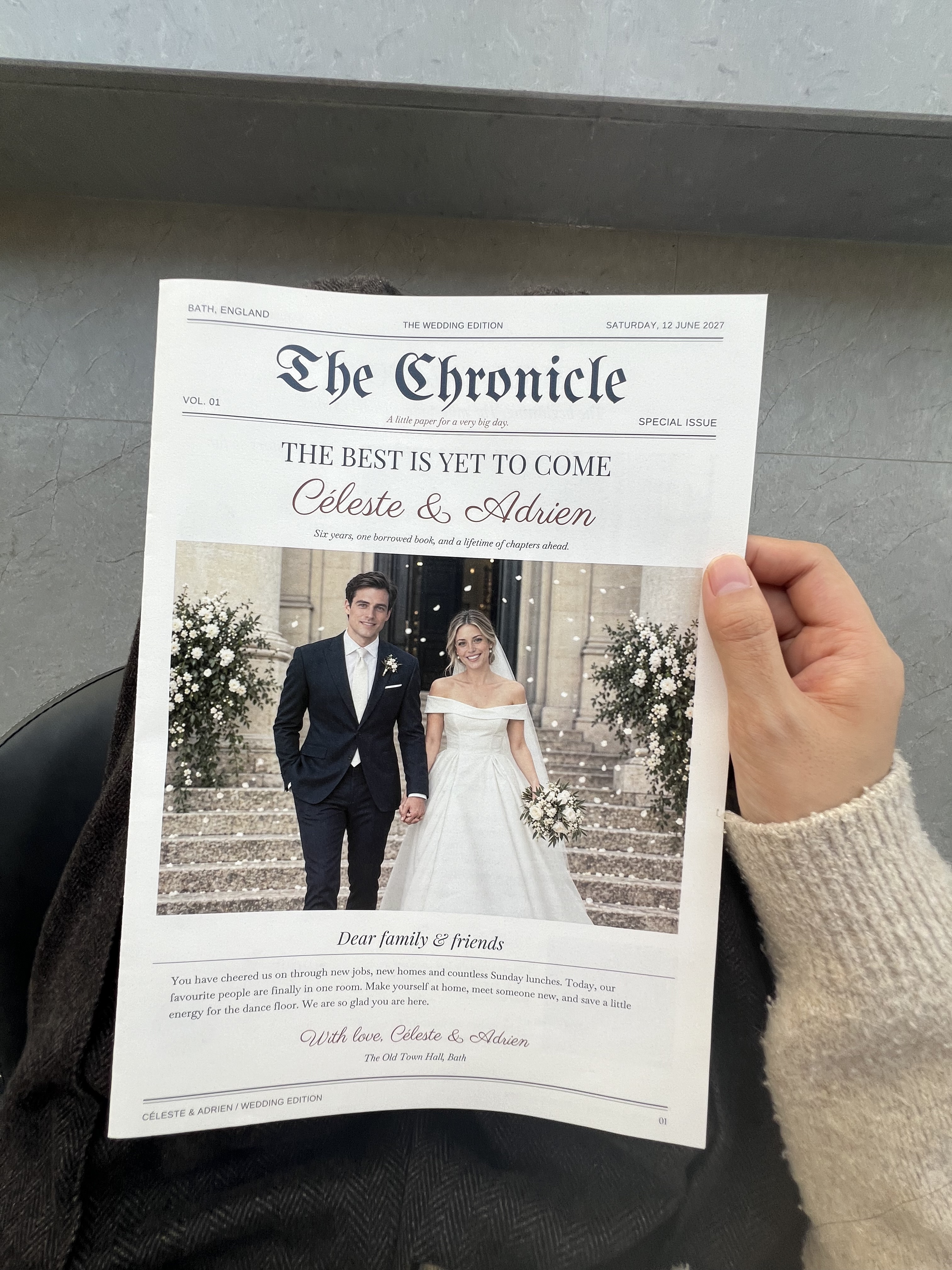
Start with how guests will use the paper, then count the places it needs to reach. A ceremony programme, a shared table activity and a take-home keepsake can call for very different quantities—even at the same wedding.
Do you need one wedding newspaper per guest?
Only if you want everyone to have their own. For shared reading or household keepsakes, count the actual sharing groups or table allocations instead. Add copies for separate keepsakes, additional evening guests and a chosen reserve. Count reused ceremony copies only once, with an agreed way to move them to the reception.
1. Choose what each copy is meant to do
Before looking at a printer’s price slider, decide whether guests need their own paper at a particular moment. If everyone needs to follow a ceremony running order, individual copies may be worth the cost. If the newspaper is something to browse over dinner, guests can share. If it is a favour to take home, count the people or households you actually want to give one to.
| Distribution | How to count | Check before choosing it |
|---|---|---|
| One per guest | Count guests who will receive a paper, plus any separate copies for the couple or suppliers. | Will children receive their own? Do you need individual puzzle sheets or ceremony instructions? |
| One per couple or household | Count the actual sharing groups on your guest list, including solo guests. | A table of eight is not necessarily four couples. Decide whether adult relatives travelling together will want separate keepsakes. |
| Shared on reception tables | Set a number for each table, then add those quantities. | Can guests reach a copy without passing it down a long table? Does each team need a separate game? |
| A welcome display | Choose a planned stock for the display and a separate refill bundle. | A stack does not guarantee every guest gets one. Choose this when taking a paper is optional. |
Think about accessibility as well as arithmetic. Sharing should be comfortable, with enough light and room to hold the page. A small number of individual copies can sit alongside a table-sharing plan. If the paper only contains a short ceremony summary, check whether a separate order-of-service booklet is still needed; our programme guide explains the difference.
2. Build a count without counting the same copy twice
Use this as a planning formula, with every number representing a physical copy:
Print quantity = first distribution + additional copies needed later + separate keepsakes and supplier copies + a chosen reserve.
The important word is additional. Giving out 80 copies before the ceremony and wanting newspapers at dinner does not automatically mean ordering another 80. But reuse only works if someone will move the copies, guests are asked to carry them, or the reception tables do not require a guaranteed number.
Count sharing groups from the guest list
Add a “newspaper group” column to your RSVP list. Two partners sharing one copy receive the same group label; a solo guest has their own. Count the distinct groups rather than dividing the headcount by two. Decide explicitly how to handle families with children, friends attending together and guests staying in different homes. You are choosing a distribution policy, not judging anyone’s relationship.
Separate keepsakes from papers used during the day
Set aside your own clean copies before putting newspapers out. Add copies for anyone absent whom you have actually decided to send one to. Ask your photographer or planner whether they want a separate clean copy or can use one from your keepsake bundle. Do not add another allowance for the same recipient in two places.
Choose a reserve for a reason
There is no universal requirement to order ten per cent extra. List the uncertainties: a few pending RSVPs, possible damage while travelling, guests who may want separate copies, or evening arrivals whose numbers are not confirmed. Choose a reserve you can explain and afford. If your guest list and table plan are fixed, a smaller allowance may be enough; if replacements cannot arrive before the wedding, you may prefer more.
3. Three worked examples
These are invented planning examples, not customer averages or recommended quantities for every wedding. Change the sharing plan and allowances to fit your guest list.
A 60-guest wedding with one keepsake per sharing group
The list contains 24 pairs and 12 solo guests: 48 + 12 = 60 guests, but 24 + 12 = 36 sharing groups. The couple want two clean copies for themselves and three for absent relatives. They choose four reserve copies. The print order is 36 + 2 + 3 + 4 = 45 copies.
Simply halving 60 would have produced 30, leaving six groups without a copy even before keepsakes. Conversely, printing 60 for distribution would give some groups two copies when the couple only intended one.
A 120-guest wedding with shared reception copies
There are 12 tables of ten. The couple choose three copies per table for conversation and a team quiz: 12 × 3 = 36. They add two for a welcome display, four clean keepsakes, two separate supplier copies and six reserves. Total: 36 + 2 + 4 + 2 + 6 = 50 copies.
This works only if sharing is the intention. If all 120 guests should complete their own crossword on the newspaper, 36 table copies do not meet that goal. Either order individual copies or provide separate activity sheets. If guests will take the papers home, tell the person refilling the display that the table allocation is already reserved.
An 80-guest ceremony followed by 20 evening-only guests
Every ceremony guest receives a copy. An usher asks guests to take it to the reception, so the couple do not also promise copies on every dinner place setting. The 20 evening-only guests receive one each on arrival. Four clean copies are held for the couple and family, and six are reserves. Total: 80 + 20 + 4 + 6 = 110 copies.
If the venue instead requires 30 newspapers to be waiting on dinner tables before the ceremony finishes, those cannot depend on copies still in guests’ hands. Add 30 to the plan, or change the setup. A reuse plan saves copies only when the timing and handoff are practical.
4. A copy-count worksheet to share with your planner
Fill this in after deciding on distribution. Use zero for rows you do not need, and give the completed version to whoever will place the order.
First distribution: ___ guests / ___ sharing groups / ___ tables × ___ copies = ___
Evening-only or other additional distribution, excluding people above: ___
Clean keepsakes, absent recipients and separate supplier copies: ___
Reserve for these specific uncertainties: ___
Total finished newspapers to order: ___
Copies being reused, moved by whom and when: ___
Latest guest-list check and person approving the quantity: ___
Check children, the wedding party and the couple against the same list. Sometimes they are already included in the headcount, sometimes not. Add venue staff or suppliers only if you intend to give them a copy; they do not automatically need one because they appear in the catering total.
5. Check what the printer means by “copies”
Ask for a quantity of complete, finished newspapers at the agreed page count and size. Four pages do not mean four newspapers. For a four-page edition printed on one sheet, both sides are printed and the sheet is folded once. Larger editions and different production methods can use a different number of sheets.
Confirm whether folding is included and whether you will receive finished copies or unfolded sheets. Match the file to the printer using our flat and folded size guide. Do not multiply the order because your Vowfold download contains five PDF formats: they are alternative formats of the same four-page edition.
When comparing quantities, look at the extra total you would actually pay. For example, if an illustrative quote is £120 for 50 copies and £140 for 75, the additional 25 cost £20. The lower unit price is useful only if you want those extra copies and the full amount fits your budget. These figures demonstrate the calculation; they are not current printer prices.
Check any minimum order, quantity increments, proof cost, delivery and tax in the live quote. Keep a physical proof separate in your budget: if it has an earlier version of your timetable or a test photograph, it should not be counted as a usable wedding-day copy. Our print-quote checklist covers the full comparison.
6. Pack the count into a setup plan
- Label each bundle by destination. For example: “Dinner tables: 36; three per table” and “Evening arrivals: 20”.
- Protect the keepsakes. Put them in a separate flat envelope or box so they are not used to refill the display.
- Name the person moving reused copies. Agree when the room is accessible and where those papers go.
- Give one person the reserve. Ask them to use it for shortages, rather than adding it to every table at setup.
- Plan the end of the night. Decide who collects unused copies and whether guests are welcome to take extras.
A short note beside a stack can explain “Please take one per household” or “A little reading for the table—please share.” Choose wording that matches your actual quantity. Do not ask guests to take one each when there are only enough for sharing.
Common quantity questions
Is one newspaper per couple enough?
It can be, if couples are happy to share and the newspaper is not needed for individual participation. Include solo guests, decide how families share, and count the actual groups. “Half the guest count” is only accurate when every guest belongs to a pair receiving one copy.
Can one copy serve both the ceremony and reception?
Yes, with an agreed way to carry or move it. If your reception setup needs a fixed quantity before ceremony copies become available, allocate separate stock. Include evening-only guests once, rather than adding the entire reception headcount again.
Can an online edition reduce the print order?
It can provide another way to read, especially for absent guests, but does not replace an individual paper or activity you have promised. Check phone access and readability yourself. You can try Vowfold’s online sample; physical printing is arranged separately.
Should we order before the final RSVP deadline?
You can compare quotes using a provisional range, then approve the quantity once the guest count is clearer. Allow enough time for a proof, corrections, production and delivery. If you must order earlier, record the uncertain numbers and use them to choose the reserve, rather than guessing a percentage.
Editorial note: the examples and worksheet are Vowfold planning tools. They do not claim an industry standard, a minimum order or a typical guest take-home rate. Check current printer terms before ordering.